

At HKT LORA, we view smart parking as a data problem as much as a sensing problem. Cities, campuses, shopping centers, office parks, and commercial parking operators need reliable occupancy information to support guidance, enforcement, planning, and better use of existing capacity. A smart parking sensors company using LoRaWAN therefore works within a system in which field devices, gateways, network servers, and software exchange small but useful operational data.
How a Smart Parking Sensors Company Using LoRaWAN Works
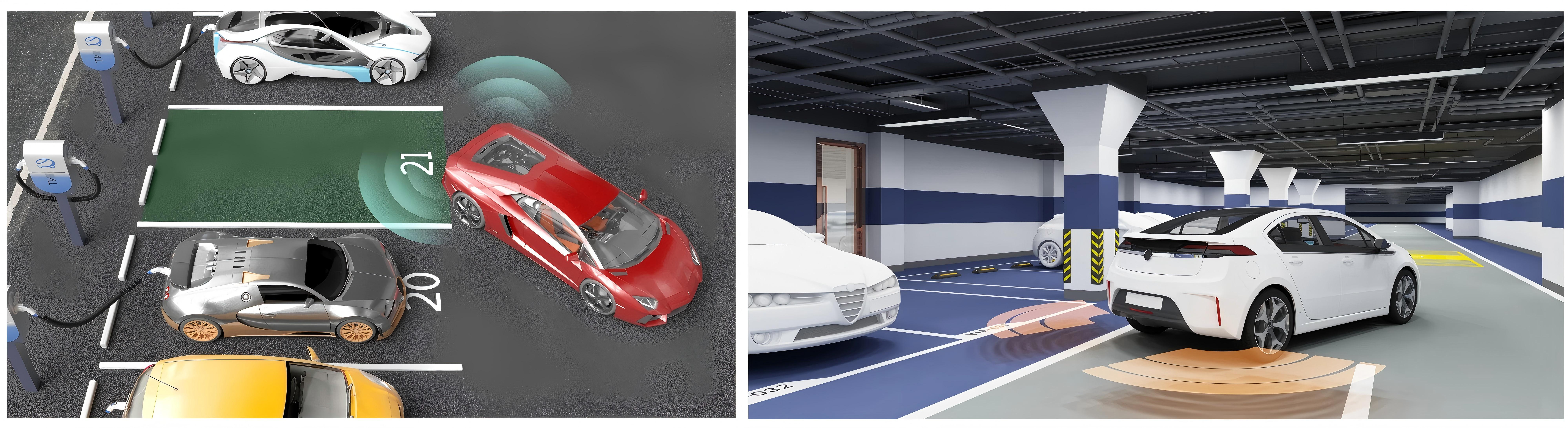
A typical smart parking architecture begins with a sensor installed at or near a parking space. Its purpose is to determine whether a vehicle has arrived or departed. Once the status changes, the device can transmit the event through a LoRaWAN network to a gateway. The gateway forwards the information to a network server and application layer, where parking software can display or process the occupancy status.
This architecture fits many parking applications because occupancy messages are small and do not require continuous high bandwidth. The LoRa Alliance identifies parking sensors among smart city devices suited to LoRaWAN networks and describes LoRaWAN as suitable for low data communication, battery operated devices, long range connectivity, and secure bidirectional communication. These characteristics matter when many distributed parking spaces need to report status without extensive cabling.
Why Parking Occupancy Data Matters
The value of a parking sensor is not limited to detecting a vehicle. The larger benefit comes from turning occupancy events into information that operators can use. When space status reaches a management platform, operators can build parking guidance functions, monitor usage patterns, support enforcement processes, or evaluate how different parts of a facility are being used.
For drivers, better occupancy information can reduce unnecessary searching inside a parking area. For operators, historical records can reveal busy periods, underused zones, or recurring demand patterns. The LoRa Alliance describes parking management as a smart city use case in which spaces can be monitored more efficiently and parking providers can adapt operations to real world usage patterns.
What Sensor Deployment Requires
Wireless communication does not remove the need for careful deployment planning. Parking environments can include underground structures, dense urban streets, moving vehicles, metal objects, water exposure, and different installation surfaces. Project teams should consider where devices will be installed, how gateways will cover the site, what frequency band is required, how maintenance will be handled, and how data will enter the existing parking platform.
Detection technology also deserves attention. Devices may use magnetic sensing, radar, ultrasonic measurement, or combinations of methods. The right approach depends on the installation environment and product design. A smart parking sensors company using LoRaWAN should therefore be evaluated not only by wireless connectivity but also by detection method, environmental design, configuration options, system compatibility, and maintenance requirements.
The Importance of Network Integration
At HKT LORA, we also consider each parking sensor one endpoint in a larger IoT chain. Project success depends on whether the sensor can communicate with suitable gateways, whether the network server can interpret uplink data, and whether the application platform can use that data correctly. Standardized LoRaWAN connectivity supports integration across compatible components, but engineers still need to review regional frequency plans, payload formats, and platform requirements.
This is especially important for organizations that already operate an IoT network. Instead of treating parking as an isolated system, they may want occupancy data to enter an existing smart city, property management, or mobility platform. Planning the data path early can reduce integration work and make it easier to connect sensor events with guidance displays, dashboards, reports, or operational processes.
A Practical Parking Sensor Example
In our parking portfolio, HKT LORA offers the HKT MPS 100 surface mounted parking sensor and HKT EPS 100 embedded parking sensor. The MPS 100 detects parking space status and sends vehicle arrival or departure information through a LoRaWAN gateway to the network server and parking platform, supporting real time parking management.
For embedded installations, our EPS 100 uses geomagnetic induction together with 24 GHz microwave detection. Its official specification lists LoRaWAN 1.0.3, Bluetooth 5.1, a configurable detection distance of 0.5 to 1.2 meters, an eight second configurable detection interval, and an accuracy rate above 99 percent. Listed regional options include EU868, CN470, IN865, US915, AU915, and AS923.
Choosing Technology Around the Parking Environment
When we discuss smart parking projects, we focus on matching the sensing method, network design, installation approach, and management platform to the operating environment. Our broader LoRaWAN offering includes gateways and cloud related solutions, so parking sensors can be considered within a wider IoT architecture rather than only as standalone devices.
For organizations comparing a smart parking sensors company using LoRaWAN, the most useful questions are practical. Teams should verify how occupancy is detected, how the device communicates, which regional bands are supported, how configuration and maintenance are performed, and how sensor data reaches the intended application. Those factors provide a clearer basis for evaluating a deployment than broad marketing claims.
Building Parking Systems Around Reliable Data
Smart parking is ultimately a data management process supported by field sensing. Sensors identify occupancy events, LoRaWAN carries those events through the wireless network, and software converts them into information that operators can use. When each layer is planned carefully, parking data can support more responsive management without requiring every space to be wired into the communications infrastructure.
At HKT LORA, we keep our parking approach grounded in documented sensor functions and standardized LoRaWAN connectivity. For project planners, the key is to evaluate the complete path from vehicle detection to application data and select components whose published capabilities match the real requirements of the parking site.