

What Problem Do Farms and Utility Sites Actually Have?
Most outdoor sites share the same three constraints: no mains power, no fixed broadband, and too much ground to cover with short-range radios. A 500-hectare farm or a scattered water-metering district can’t run a cable to every sensor.
Because of this, operators end up sending staff out just to read a gauge or check a valve. That drives up labor cost and creates unwanted supply cost — trips, fuel, and truck time spent on tasks a network could handle remotely.
- No grid power at remote points
- No cellular tower or Wi-Fi router nearby
- Wide, irregular terrain (fields, pipelines, reservoirs)
- Dozens to thousands of endpoints to track
This is why a single, wide-reaching wireless layer — not a patchwork of short-range devices — has to sit underneath any smart agriculture or metering program.
Why Does LoRaWAN Outperform Wi-Fi and Cellular Outdoors?
LoRaWAN wins outdoors because one gateway can hear battery-powered sensors kilometers away, on free spectrum, with no per-device subscription. Wi-Fi tops out at roughly 50–100 meters and drains batteries in hours to days, while cellular modules add a recurring SIM cost per node.
LoRaWAN instead runs in unlicensed ISM bands — 868 MHz in Europe, 915 MHz in North America — using chirp spread-spectrum modulation that trades bandwidth for distance and battery life measured in years rather than days.
|
Technology |
Typical outdoor range |
Battery life |
Ongoing cost per device |
|
Wi-Fi |
50–100 m |
Hours to days |
None, but short range limits use |
|
Cellular (NB-IoT/LTE) |
1–10 km |
Months to a few years |
SIM/data subscription |
|
LoRaWAN |
2–15 km |
Years |
None (unlicensed band) |
Source: element14 Community, “LoRaWAN for IoT Applications”; AWS IoT LPWAN whitepaper.
How Far Can an Outdoor LoraWAN Base Station Really Reach?
An outdoor LoRaWAN base station can provide long-range coverage, with actual distance depending on terrain, antenna placement, obstacles, and network design. In open, line-of-sight environments, coverage can reach up to 15 km. For a farm or utility corridor with clear sightlines, that means one gateway can realistically stand in for several short-range access points.
How Does an IP67 LoRaWAN Outdoor Gateway Support Remote Deployments?
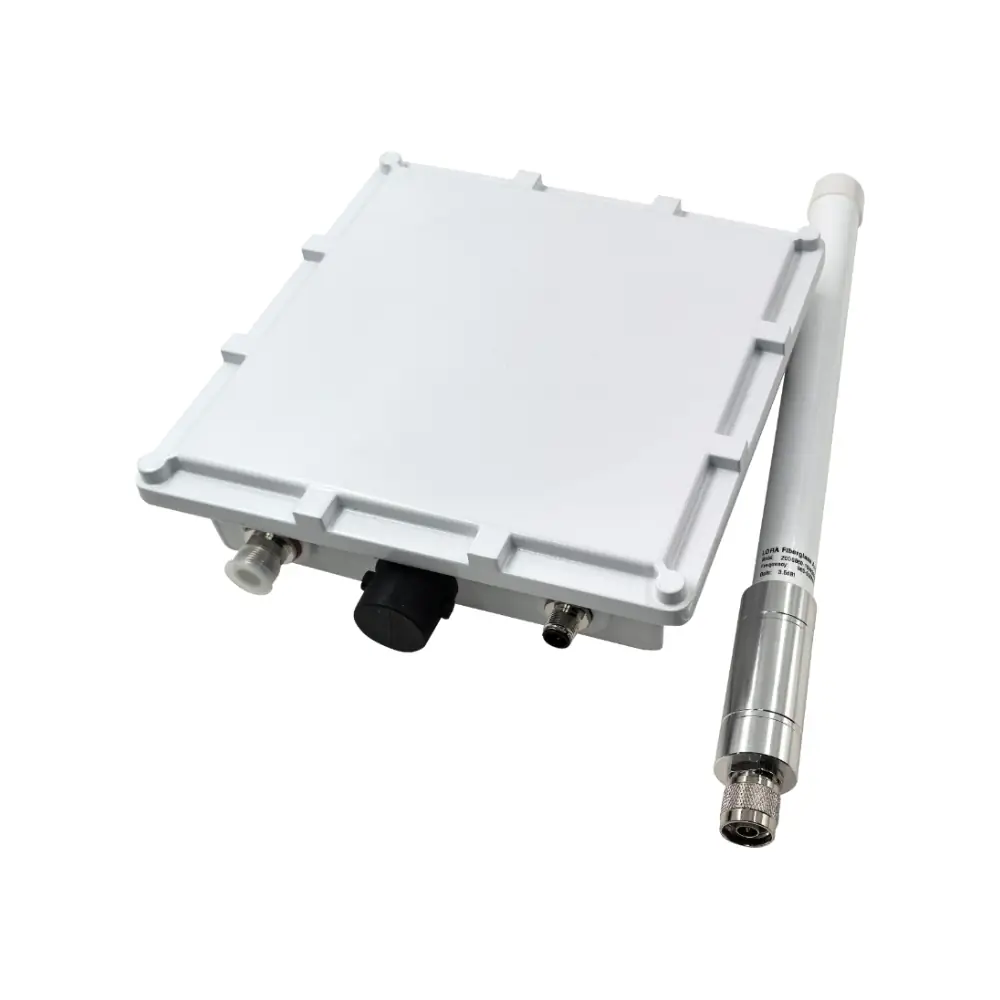
HKT LORA builds exactly this kind of hardware: an IP67 LoRaWAN outdoor gateway with 8 channels, an X1302 LoRa chip, and a quad-core CPU, rated to connect more than 2,000 nodes from a single unit, depending on network configuration and traffic patterns. It supports line-of-sight range up to 15 km and ships in a fully sealed IP67 enclosure, so it keeps working through rain, dust, and temperature swings without a shelter.
For backhaul, the gateway connects via Ethernet, Wi-Fi, or cellular, and forwards data to common network servers — AWS IoT, The Things Network, ChirpStack, Loriot, and Everynet — so it drops into whatever platform an operation already runs.
That combination matters operationally: one gateway aggregating thousands of nodes becomes a single management access point. Instead of checking equipment site by site, a team monitors the whole area from one dashboard, with regular data updates reducing the need for manual site visits and helping lower labor and operating costs.
How Is LoRaWAN Used in Smart Agriculture?
LoRaWAN lets farms irrigate on demand, based on actual soil-moisture readings, instead of running pumps on a fixed timer.A field study cited by the U.S.General Services Administration found that Wireless soil-moisture-based irrigation controllers reduced water use by 20% to 40% compared with timer-only systems.
In practice, moisture and water-level sensors scattered across a field report back to one outdoor gateway. The farmer only opens a valve when the soil actually needs it. As a result, water use drops, pump run-time drops, and nobody has to walk the field to check conditions by hand.
How Is LoRaWAN Used in Smart Metering?
For utilities, LoRaWAN turns manual meter reading into a continuous, automatic feed. A gateway placed across a service area relays water, gas, or electricity meter data at configured reporting intervals, allowing operators to identify anomalies sooner rather than waiting for the next scheduled manual visit.
This removes the need to dispatch a technician for routine reads across a spread-out district. Thousands of meters report into one system, giving the utility one place to watch usage, spot leaks early, and plan maintenance instead of reacting to complaints.
How Do You Choose the Right LoRaWAN Gateway Supplier?
Sizing a deployment starts with three questions: how many endpoints need to connect, how open or obstructed the terrain is, and how exposed the gateway itself will be.
- Node count: Confirm the gateway’s rated capacity — for example, 2,000+ nodes on a single HKT LORA outdoor unit — against your current sensor count plus expected growth.
Terrain: Open farmland or utility corridors may benefit from longer line-of-sight coverage, while hilly or heavily built environments may require additional gateways.
Environmental rating: For gateways installed on exposed poles towers, or masts, an appropriate ingress protection rating such as IP67 can help protect the enclosure against dust and water exposur.
- Backhaul: Choose Ethernet where cabling exists, or Wi-Fi/cellular for sites without a fixed line.
Beyond specifications, the LoRaWAN gateway supplier also matters. HKT LORA supports outdoor gateway projects with sample and small-batch orders, OEM/ODM customization, and technical support. Configuration options can be adjusted to specific project requirements.

Conclusion
Outdoor coverage low power consumption, and operation in unlicensed spectrum make LoRaWAN well suited to agriculture and metering deployments where long-range, low-power connectivity is required. Built around specifications like these, an outdoor gateway from a supplier such as HKT LORA gives an operation one access point to manage many endpoints — reducing the labor and site-visit costs associated with managing large areas manually while providing regular data updates.