

Temperature and humidity are two of the most widely monitored environmental variables because they influence product storage, building conditions, agriculture, industrial processes, and equipment operation. At HKT LORA, we approach environmental monitoring as a data chain that begins with sensing and continues through wireless transmission, network processing, alerts, and practical action.
A LoRaWAN temperature & humidity sensor is useful when measurements need to be collected from distributed locations without relying on a wired data connection at every point. The sensor measures local conditions, packages the readings into data messages, and sends them through a LoRaWAN network so operators can review environmental changes from a central platform.
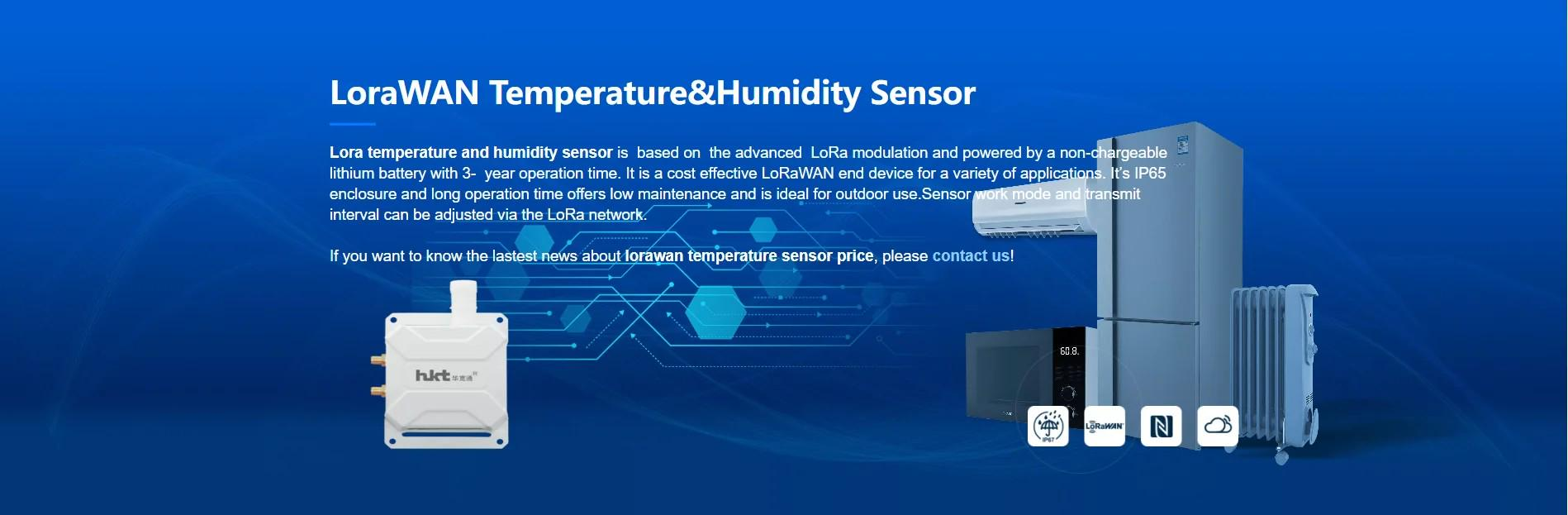
What a LoRaWAN Temperature & Humidity Sensor Actually Measures
Temperature describes the thermal condition around the sensing element, while relative humidity describes the amount of water vapor in air relative to the amount the air can hold at the same temperature. Because relative humidity changes with temperature, the two readings are often evaluated together rather than treated as unrelated values.
This relationship matters in practical monitoring. A warehouse may remain within an acceptable temperature range while humidity rises to a level that increases moisture risk. In a greenhouse, the same temperature can produce different growing conditions when humidity changes. Monitoring both variables gives operators a fuller view of the environment than either measurement alone.
How LoRaWAN Carries Sensor Data
LoRaWAN is a low power wide area networking protocol designed to connect battery operated devices over wide areas. The LoRa Alliance describes a star of stars architecture in which end devices communicate with gateways, and gateways relay their messages to a central network server through standard IP connections.
For environmental monitoring, the sensor is the end device. It does not need to send continuous high bandwidth data such as video. Instead, it can report compact temperature and humidity readings at configured intervals or when an event requires attention. This communication pattern is one reason LoRaWAN is used in distributed monitoring applications.
A LoRaWAN temperature & humidity sensor still depends on good network design. Building materials, gateway location, antenna arrangement, terrain, installation height, and local radio conditions can affect communication. Published maximum ranges should therefore be treated as reference figures rather than guaranteed performance at every site.
Why Reporting Intervals Matter
More frequent reporting creates a more detailed environmental record, but it also increases wireless activity and power consumption. A longer reporting interval reduces transmissions but may provide less detail about short term changes. Selecting the interval should therefore reflect the operational purpose of the monitoring system.
A cold storage area, for example, may require different reporting behavior from a general warehouse. Threshold alarms can also complement periodic reporting by drawing attention to specific conditions instead of relying only on routine data collection. The appropriate settings should be based on how quickly conditions can change and how soon an operator needs to respond.
Where Temperature and Humidity Monitoring Adds Value
Warehouses can use environmental readings to observe storage conditions and identify areas that behave differently from the rest of the facility. Agricultural sites can monitor greenhouses or other growing environments. Industrial operators may use distributed sensors to understand environmental conditions around equipment, materials, or production areas.
Building applications are another common case. Temperature and humidity data can help facility teams compare zones, investigate comfort complaints, or identify areas where environmental conditions consistently differ. The readings do not replace HVAC controls or professional building analysis, but they provide evidence that can support those processes.
Placement Is as Important as Sensor Accuracy
A technically capable sensor can still produce unrepresentative data if it is installed in the wrong place. Direct sunlight, heat producing machinery, doors, vents, wet surfaces, or localized airflow can influence readings. Sensor placement should represent the environment that the project actually intends to monitor.
Multiple sensors may be more useful than one device in a large or irregular space. Before installation, teams should identify monitoring zones, define acceptable ranges, decide how alarms will be handled, and determine who is responsible for responding when readings move outside expected limits.
A Product Example From Our Environmental Monitoring Portfolio
Our HKT LORA GT-30 provides one example of a LoRaWAN environmental monitoring device. According to the official product specification, it combines temperature and humidity acquisition with GPS positioning and an accelerometer, uses standard LoRaWAN communication, and supports motion detection, positioning, environmental data collection, and threshold alarm functions.
The GT-30 specification lists a temperature measurement range from minus 30 to 70 degrees Celsius. Temperature acquisition accuracy is listed as plus or minus 0.3 degrees Celsius from 0 to 70 degrees and plus or minus 0.6 degrees Celsius from minus 30 to 0 degrees. The device is rated IP67 and uses OTAA or ABP in Class A operation.
Its listed LoRaWAN frequency options include EU868, US915, AU915, KR920, and AS923. The product page also states that the unit uses two 8000 mAh ER18505 lithium batteries and specifies a battery life above three years under the reporting and alarm conditions defined on that page.
Turning Environmental Readings Into Decisions
When evaluating a LoRaWAN temperature & humidity sensor, we recommend looking beyond a single accuracy figure. Measurement range, installation environment, reporting strategy, alarm behavior, network compatibility, gateway coverage, enclosure protection, power requirements, and data platform integration all influence whether the system fits the intended application.
At HKT LORA, we see temperature and humidity monitoring as one layer of an IoT system rather than an isolated sensor purchase. A well planned deployment connects representative measurements with suitable reporting intervals and reliable network architecture, giving operators environmental data that can be interpreted and acted on in warehouses, agriculture, buildings, and industrial settings.