

Environmental monitoring is most useful when data reflects the conditions that matter to operations. At HKT LORA, we see temperature and humidity monitoring as a planning task rather than only a sensor selection task. The device, installation point, reporting schedule, network coverage, and alarm rules all influence whether the resulting data supports practical decisions.
For organizations comparing lorawan sensors for temperature and humidity monitoring, the first question should be what needs to be monitored and why. Warehouses, greenhouses, commercial buildings, and industrial sites may track the same variables, but their acceptable ranges, response times, and installation constraints can differ.
Define the Monitoring Objective First
A monitoring project should begin with the operational risk or decision that the data will support. A warehouse may want to identify zones that become too warm or humid. A greenhouse may need environmental data to support ventilation and irrigation decisions. A facility manager may want to compare indoor conditions across rooms or floors.
This step helps determine how many sensors are needed and where they should be placed. One device in a large space may not represent the entire environment. Temperature can differ near doors, ceilings, machinery, windows, or ventilation outlets, while humidity can vary around wet processes, storage areas, or poorly ventilated corners.
Plan LoRaWAN Sensors for Temperature and Humidity Monitoring Around Placement
Sensor placement should avoid locations that distort the measurement unless those locations are the actual monitoring target. Direct sunlight, heaters, cooling vents, exterior doors, steam sources, and heat producing equipment can create local conditions that do not represent the wider area.
For lorawan sensors for temperature and humidity monitoring, placement also affects wireless performance. A suitable monitoring point may have weak radio conditions because of concrete walls, metal structures, below grade locations, or surrounding machinery. Planning should therefore consider both environmental representativeness and LoRaWAN connectivity before devices are permanently installed.
Set Reporting Intervals Around Operational Needs
Reporting frequency determines how much detail operators receive about changing conditions. Short intervals can reveal rapid variations, while longer intervals can suit environments that change slowly. More frequent transmissions also increase radio activity and can influence battery consumption, so the interval should match the monitoring objective.
Threshold alarms can complement scheduled reporting. A sensor that supports configured thresholds can notify the system when conditions move outside defined limits. The thresholds themselves should come from the requirements of the stored product, process, building, or agricultural application rather than from a generic setting.
Plan the LoRaWAN Network Separately
LoRaWAN is designed for low power wide area IoT communication. In a typical architecture, end devices transmit to gateways, and gateways forward messages to a network server through IP connections. This allows distributed sensors to report compact measurements without requiring a wired data connection at every monitoring point.
Gateway placement should be based on the actual building or site. Walls, terrain, equipment, antenna height, and local radio conditions influence communication. Published maximum range figures are useful references, but they should not be treated as guaranteed coverage for every deployment.
A site survey or pilot installation can help identify weak areas before a large rollout. This is particularly valuable when sensors will be placed across several floors, warehouses, outdoor zones, or mixed indoor and outdoor environments.
Evaluate Data Quality Beyond Accuracy
Accuracy matters, but it is only one part of data quality. Teams should also consider measurement range, resolution, installation method, enclosure protection, calibration requirements, and whether the device continues to represent the environment over time.
Humidity deserves particular attention because relative humidity depends on temperature. A temperature change can alter relative humidity even when the actual moisture content of the air has not changed. Reviewing both measurements together gives operators more context than treating either value alone.
Someone should also be responsible for reviewing alarms, investigating abnormal readings, and deciding whether maintenance, ventilation, environmental control, or another action is needed. Data that nobody reviews has limited operational value.
Match Device Features to the Deployment
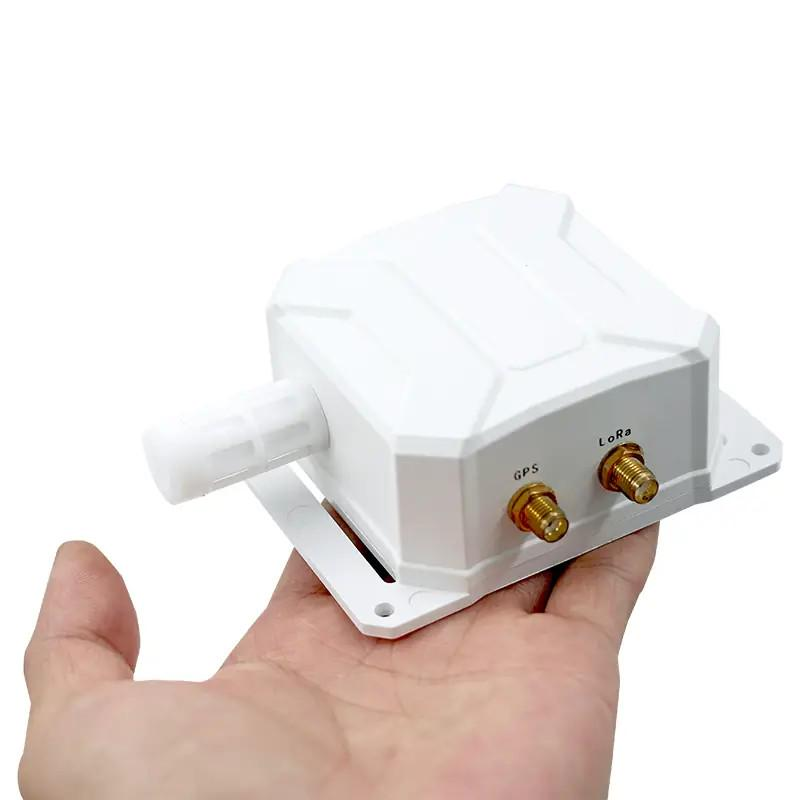
Near the product selection stage, our HKT LORA GT 30 provides one example of a device designed for distributed environmental monitoring. The official specification lists a temperature range from minus 30 to 70 degrees Celsius, with accuracy of plus or minus 0.3 degrees Celsius from 0 to 70 degrees and plus or minus 0.6 degrees Celsius from minus 30 to 0 degrees.
The GT 30 also lists a humidity range of 0 to 100 percent relative humidity and humidity acquisition accuracy of plus or minus 3 percent within the specified 10 to 90 percent RH range. It supports standard LoRaWAN communication, EU868, US915, AU915, KR920, and AS923 frequency options, and OTAA or ABP Class A operation.
Its official page also specifies IP67 protection, wall mounted installation, GPS positioning, an accelerometer, motion detection, temperature and humidity collection, and threshold alarm functions. The device uses two 8000 mAh ER18505 lithium batteries, with battery life stated as more than three years under the reporting and alarm conditions defined in the product specification.
Build Monitoring Around Decisions
A reliable deployment of lorawan sensors for temperature and humidity monitoring, starts with the environment rather than the device alone. Project teams should define the conditions that need to be monitored, select representative installation points, set suitable reporting and alarm rules, verify gateway coverage, and decide how the collected data will be reviewed and acted on after deployment.
At HKT LORA, we see the sensor as one part of that workflow. Suitable measurement range, network compatibility, enclosure design, power planning, and clear operating procedures all contribute to a useful monitoring system. The goal is to place the right sensors where the resulting data can support a specific operational decision.