

Gas utilities and property management firms require consistent and accurate measurement for billing and resource management. The diaphragm gas meter has been a trusted technology for this task for decades, and its integration with modern networks has significantly enhanced its utility. At HKT LORA, we work with the communication systems that bring this data to life. We believe it is valuable to understand both the enduring mechanical principles and the modern wireless capabilities of these devices. So, how does a diaphragm gas meter work, and what does its evolution into a smart device mean for your operations?
The Foundational Principle of Volume Measurement
The operation of a diaphragm meter is based on a precise mechanical process. In essence, the meter answers the question of how does a diaphragm gas meter work through a system of flexible chambers. As gas flows into the meter, it fills these chambers, causing the diaphragms to inflate and deflate in a alternating sequence. This movement actuates a series of levers and a crank, which in turn rotates a set of dials. Each cycle corresponds to a specific, calibrated volume of gas that has passed through. This mechanical counting mechanism is what provides the fundamental consumption data, a method prized for its long-term reliability and accuracy without needing an external power source for the measurement itself.
From Mechanical Reading to Digital Intelligence
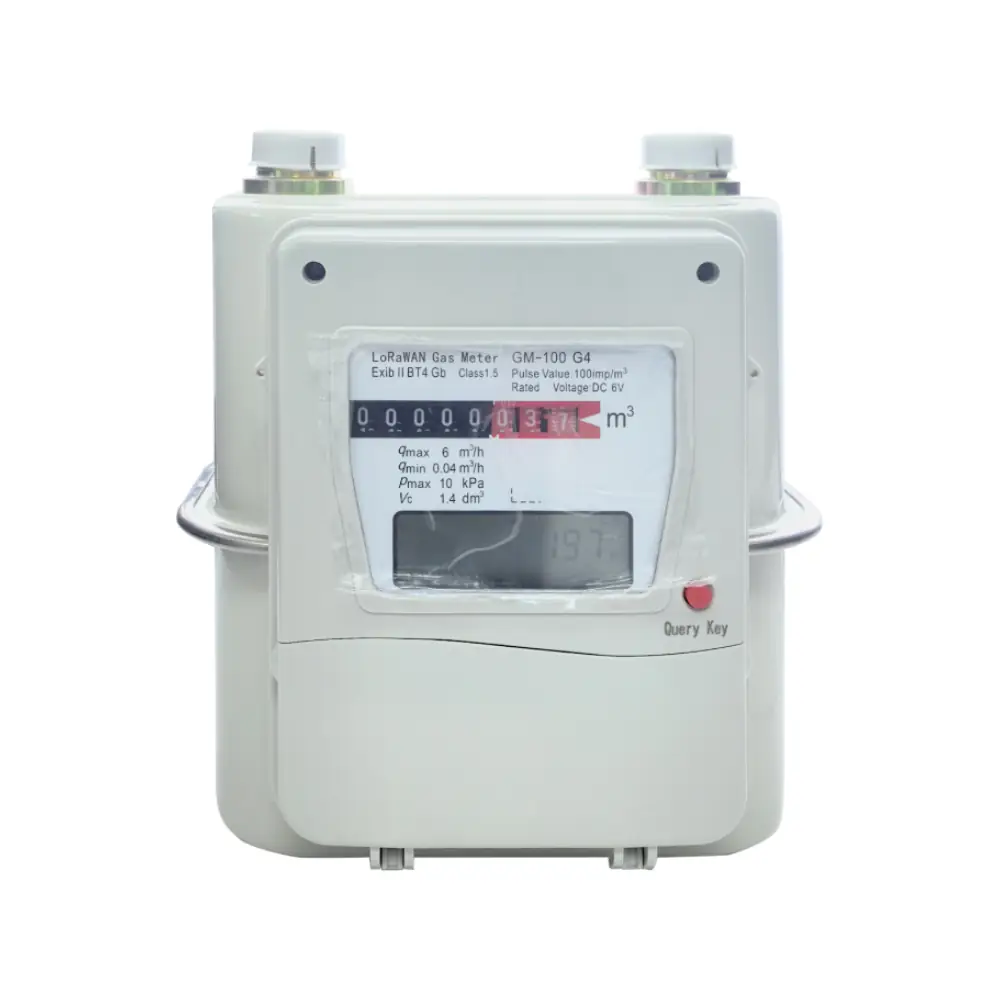
While the internal measurement method remains mechanical, the way data is collected has been transformed. Modern versions, like our LoRaWAN Diaphragm Gas Meter, retain this proven mechanical core but add a digital layer. An integrated sensor detects the rotations of the mechanical register, converting them into digital readings. This data is then displayed on a clear LCD screen, showing not only the total consumption but also vital system statuses like battery life and valve position. Furthermore, these meters can store over 10,000 historical records locally, creating a robust data log for auditing and analysis, all while maintaining the core principle of how does a diaphragm gas meter work.
Enabling Remote Data with LoRaWAN Connectivity
The most significant advancement is in data transmission. This is where the HKT LORA solution adds a critical layer of efficiency. The meter uses the standard LoRaWAN® protocol to wirelessly send gas consumption data at regular intervals. With a communication range of up to 5Km in open environments and a battery life designed to last for three years, these devices offer extensive coverage with minimal maintenance. They are compatible with standard LoRaWAN® gateways, and our own HKT gateway allows for fast connection to the cloud platform without complex configuration, seamlessly bridging the gap between the physical measurement and digital management.
The combination of a time-tested mechanical design with robust, long-range communication creates a powerful tool for utility management. Understanding how does a diaphragm gas meter work at its core reveals a reliable measurement engine, while the addition of smart features enables remote reading, detailed consumption analysis, and proactive system management. This evolution supports more efficient operations for utility providers. At HKT LORA, our role is to ensure that the communication link for this valuable data is as reliable and seamless as the mechanical measurement itself, providing our clients with a complete and trustworthy metering solution.